I was reminded recently that our creative work has two lives: One that begins at the moment of creation and a second that takes off when we share it with the world. With that second life the work is no longer in our hands and it can take on surprising meanings.
This is a story about the second life, and - to a lesser degree - the value of pulling on threads that pique our curiosity.
Pulling threads
Every year the Anaheim Convention Center in southern California fills with more than 60,000 musicians: players, recording engineers, audio professionals, equipment vendors, and assorted weirdos. Of these attendees, 16% are international visitors, 4% will be seen sporting a questionable leather jacket of some vintage, and 2% will look as if they haven't left the house in a year. [^1]
Also, Stevie Wonder will be there.
This is NAMM; a global expo for musical instruments, pro audio equipment, music software, big speakers, and even bigger lines for bland food. All right across the street from Disneyland, in the shadow of The Mouse.
The ACC's great halls total roughly 668,000 square feet and are the kind of massive structures reserved for indoor arenas, aircraft hangars, mausoleums to your dead wife, and - of course - conventions. [^2]
Every year NAMM becomes the epicenter of music equipment and fills up with all manner of attention-seeking attractions: electric guitarists shredding, horns honking, drummers hitting, and speakers speaking.
Loudly.
All at once, and with little regard for their neighbor.
It is a Guitar Center showroom times 1,000. Also, a great place to catch ill. [^3]
So imagine my surprise three weeks when I heard something familiar amidst the circus. Through the cacophony I something caught my ear.
"I know this. What is that?"
Rising from my seat, I sniff out the source of the familiar sound like a bloodhound for audio traveling from booth to booth.
And I find it.
There at the ATC Loudspeakers booth I hear it booming from a massive sound system. Clear as day and as loud as a concert:
"I made this record!"
It is Queen Mary, a record that I co-wrote, produced, and mixed for the artist Francine Thirteen. We made it so long ago that I had all but forgotten about it.
Now, 12 years later, it is booming at me from a $35,000 sound system for reasons that I don't yet comprehend. In the epicenter of music merchants.
Cool.
"People have been asking me to play it all day." the booth representative tells me when I ask who put the record on.
They did?
I'm taken aback. The song isn't exactly popular. Francine and I made it on zero budget over an evening with cheap tools, I mixed the record in what amounts to a closet, and it received zero promotion at the time of it's release. [^4]
And yet there it is - against the odds - booming at me and a dozen listeners. I do not know how. I do not know why. And those hi-hats still sound great!
This story might have ended here, with me beaming and proud on the showroom floor. Pleased to know that a record I made has connected with people.
But things get deeper. And stranger.
The plot thickens
Later that evening, I am relating the story to some friends online who encourage me to share the record with them. "That's great! Share the song." "Let's hear it!"
I head to Youtube where I know the song can be found and shared.
First search, I find it. Easy.
But there's more. Additional videos. A lot more. These are different:
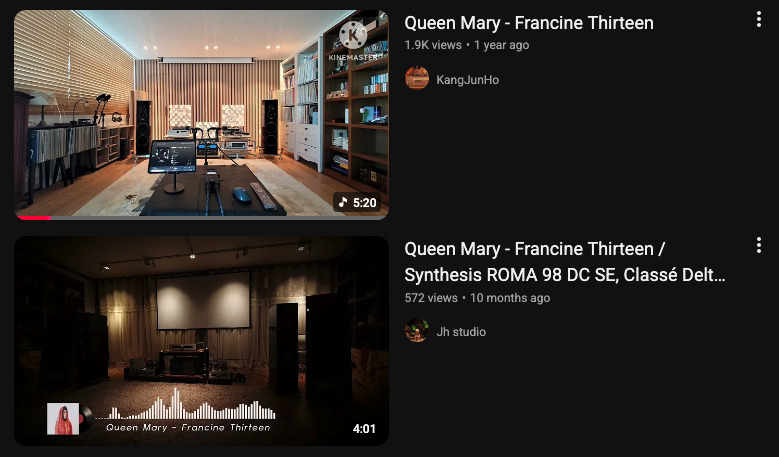
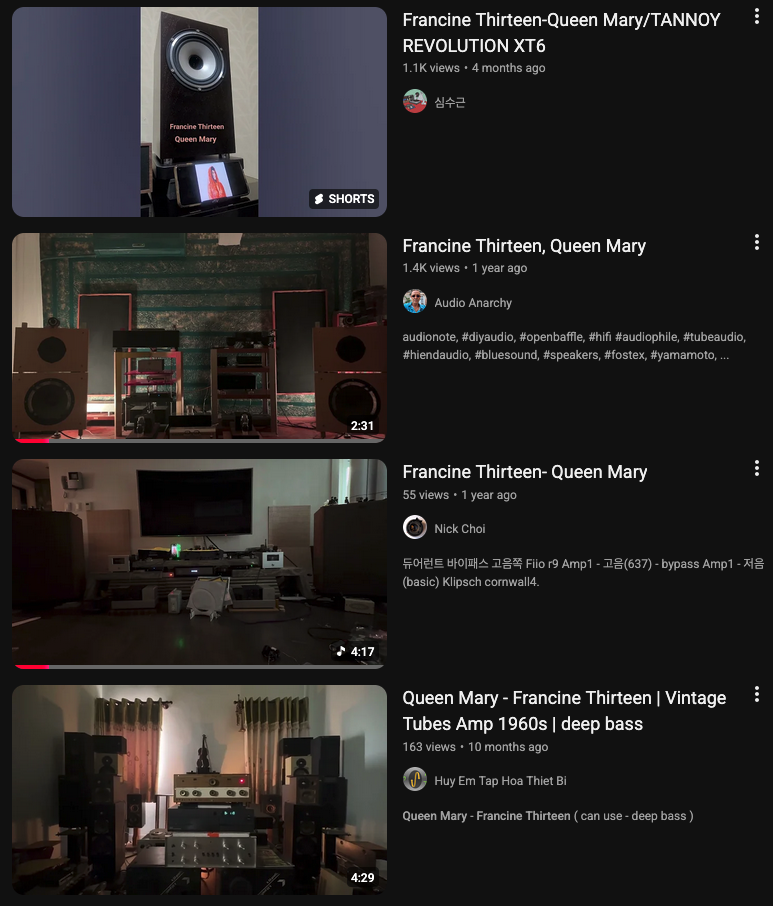
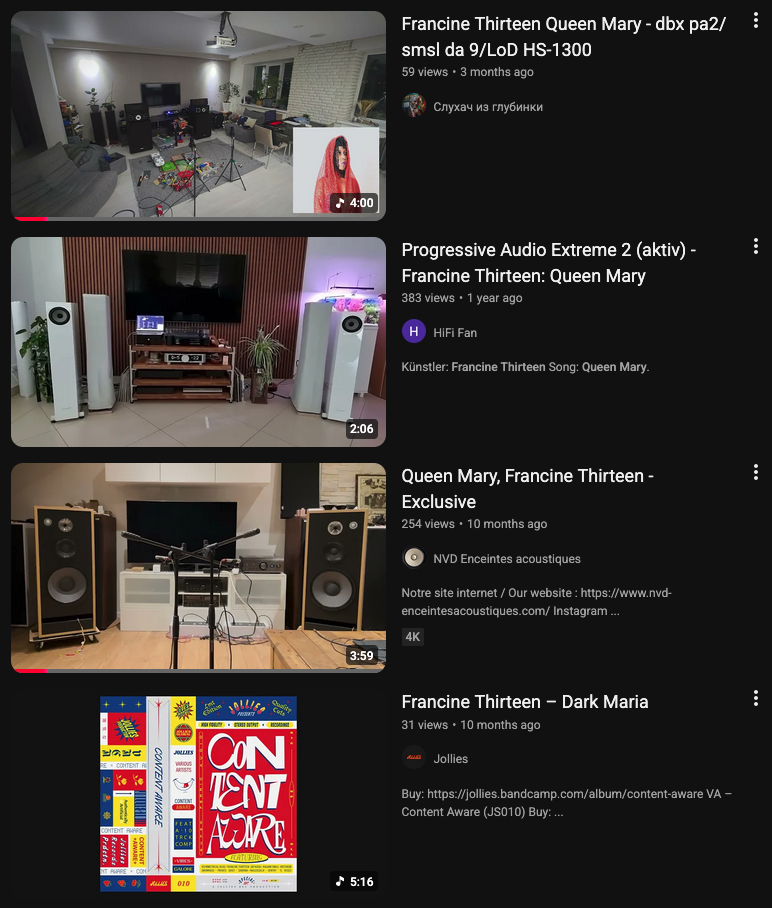
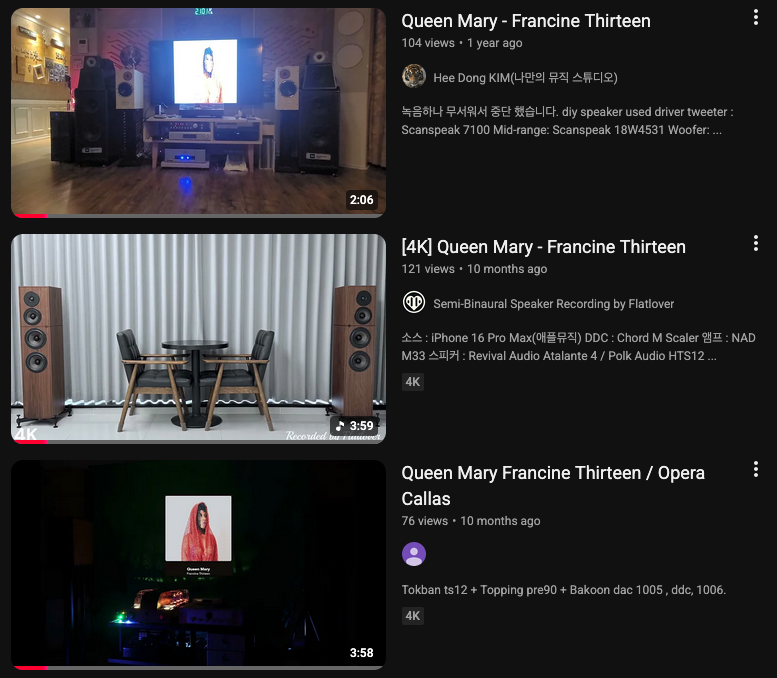
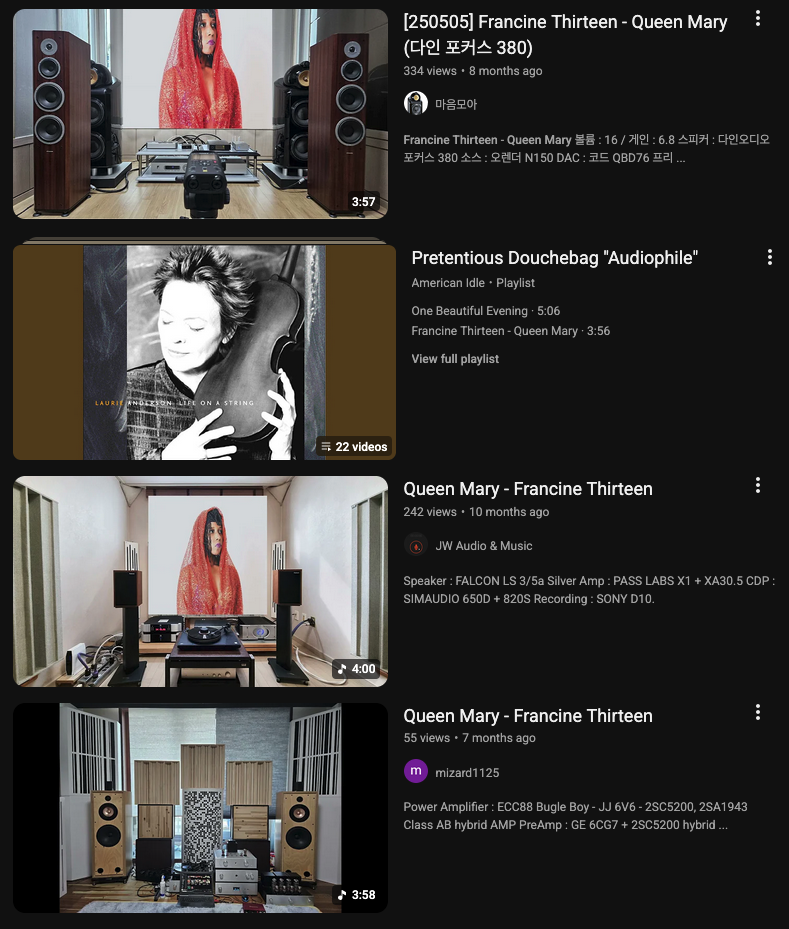
Each video follows a similar format: Music booms out of their personal hi-fi system in a living room, or a dedicated listening space with massive speakers, showy amplifiers, absurdly expensive cabling (I'll venture), and zero-to-no acoustic treatment (but I digress). [^5]
I scroll further. There are dozens of these videos(!). Some in homes. Some in studios. Some showing off their car stereos. Most appear to be filmed on a cell phone, all with one thing in common: They are playing *Queen Mary*.
What the hell.
As it turns out, hi-fi enthusiasts have been using Queen Mary as a benchmark to test-drive and show off their systems to one another. Both for the record's deep bass and immense dynamic range. As one positive video comments says:
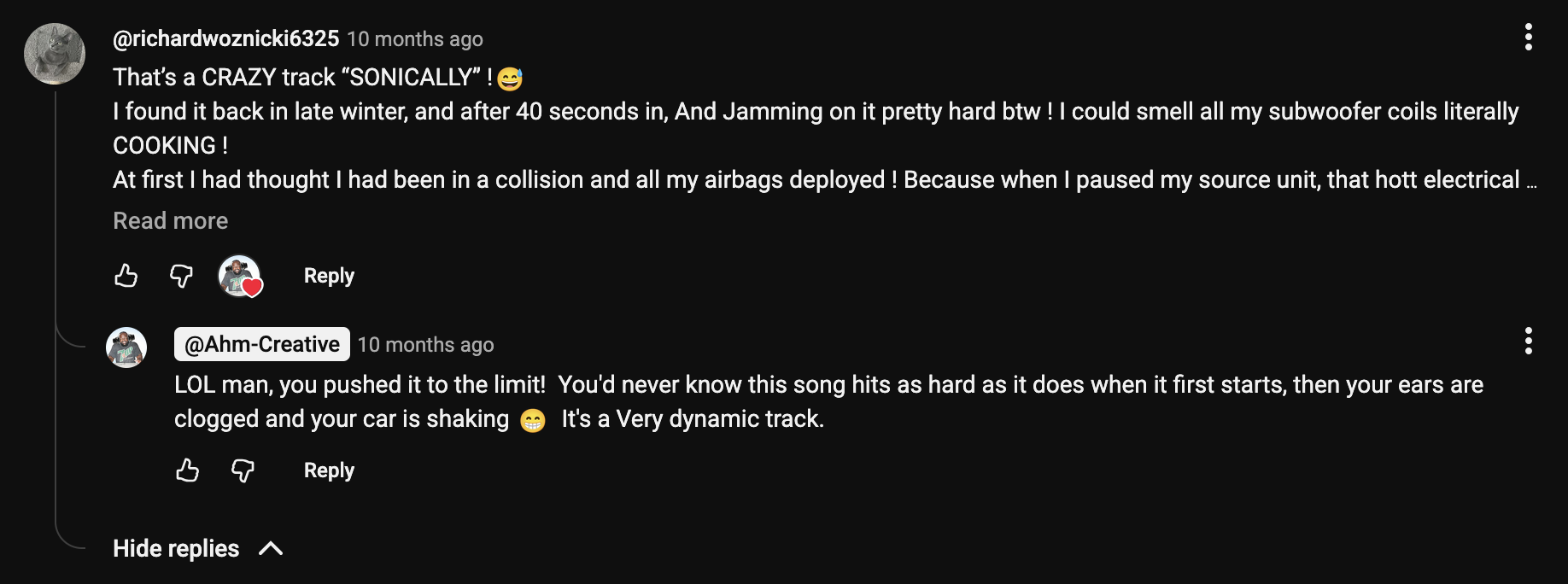
There are several videos from Korea. A handful from Vietnam. Americans. A few Russian language videos. All of them recording the sound of their system's playback. Most with the quality of a cell phone recording.
Well, Francine, I guess we made it. We're an audio benchmark.
I'm flattered by our contribution, but the whole thing puzzles me. This is a terrible way to show off your sound system.
The whole thing feels a bit silly. Watching an iPhone video of someone else's system is about as useful as watching someone else chew a hot dog and expecting yourself to appreciate the flavor notes. It's odd.
Audiophiles pride themselves on discernment and achievement of fine details. Often subtle thing. Certainly not something that can be appreciated over a phone video. Yet here they are, filming absurdly expensive rigs with the mic on their cell phone.
A brief aside about hi-fi enthusiasts
Hi-fi enthusiasts are perplexing. They have long been on record as spending extraordinary amounts of money and effort to win diminishing performance returns from their systems. No problem there. I get it.
The problem is that - at their worst - these gains can amount to little more than a placebo effect.
The audiophile space is notorious - and often teased - for such excesses and magical thinking. Enthusiasts are known to purchase system upgrades of dubious value that offer little or no perceptual improvement.
These magical upgrades are often sold at extraordinary prices by people who seemingly lack the qualification to know the difference, or who should know better than to sell them in the first place. It gets silly.
One determined audiophile in Japan famously went so far as to install their own 40’ electric utility pole in pursuit of perfect sound. As one friend once joked: "Back in my day we didn't have autism..."
So please pardon me if I find it a little funny that a record that we wrote, produced, and mixed one night in a closet is being used to flex extraordinary systems.
Conclusion
Ultimately this entire episode is a flattering one. I'm proud people have connected with our record and honored that they like it enough to use it as some standard. It's rewarding to see your creative work resonate among people.
In retrospect, I'm glad that I followed my curiosity on that NAMM showroom floor and followed a familiar sound when it presented itself. If I hadn't followed my curiosity and pulled on that thread I would never have stumbled upon this tiny pocket of enthusiasts. [^6]
In the end, I was able to explain the question of *how* and *why* our record showed up like it did. But it now raises larger questions:
What kind of madness is going on inside the audiophile community?
You can buy the record again!
People are asking me where they can purchase Queen Mary. We’ve re-uploaded it to Francine’s Bandcamp where you can purchase a copy in hi-resolution, rather than that janky Youtube rip, y'all have been getting by with in the meantime.
If you have questions about the making of the record, don't hesitate to reach out to me. If I get enough questions maybe I'll make a blog post going into the record at length.
Footnotes
[^1]: I'm being facetious, but it certainly feels this way. NAMM is one of those melting pots where all the weirdos seem to come out of the woodworks. It is A+ people watching for the musical set. Full of world class talent and world class weirdos.
The best reverb I ever heard
[^2]: The best reverb I've heard in my life was in Hall A of the Boston Convention Center in 2009, when my band members and I receive a private tour of the sub levels from the custodial staff.
Walking in from the loading dock, our guide ushers us through an unassuming door that expands into a chamber of breathtaking scale. A massive concrete hall whose scope is cathedral-esque.
Off in the distance (several hundred feet away), I see another custodian pushing a stack of a dozen rolling dollies. The squarish-kind made of 2x4s with four casters on the underside. As our guide explains the room to us, a single dolly topples from the stack and clatters loudly on the concrete floor.
The echo that follows remains - to this day - the single longest natural reverb I will experience in my life.
In all, the echo takes more than fifteen seconds to decay to silence. A kind of over-the-top echo tail you only hear in digital effects plugins and movie scores.
The echoes come in multiple distinct stages that travel to the far end of the chamber and back to us. They collide and overlap into a reverb tail that is multi-dimensional, evolving, and complex. In the same way drops of food coloring might plunge into a bowl of water and curl like smoke plumes, the echoes twist and interfere with one another in ways we cannot appreciate through our everyday (short) reverberations. It feels cosmic. The kind of grand gesture that one might imagine hearing in outer space, were it not a vacuum.
Our collective jaws drop while we stand dumbfounded and savor the experience. Once the moment has passed our guide explains to us that the chamber we stand in is only 1/3 of it's total depth. Indeed, one of the far walls is a single tremendous accordion-style partition that can be folded open and pushed to the edge of the room along tracks to expand the chamber.Our guide continues: "With all partitions open this room becomes long enough to lay the Empire State Building on it's side."
I have no doubt.
Beware: NAMM-thrax
[^3]: As you might expect, when you unite international visitors in close proximity for several days the environment becomes something of a petri dish for myriad viruses. It's common knowledge among attendees to wash your hands regularly, and don't touch too many objects lest you contract a bad case of "NAMM-thrax."
[^4]: In 2014 Francine and I don't know the first thing about promoting a record. This is, by all metrics, a minor release.
Do you want a world class studio?
[^5]: Now might be a good time to mention that I work for SDP*LA, we're a high-end recording studio design firm. So if you're reading this and want us to design a world class listening room for you and your sound system - and not some barn with a few narrow strips of magical 703 on the wall - contact me and we'll show you what a truly emotional listening experience can be.
My favorite comment
[^6]: While reviewing the dozens of Youtube videos I came across this comment which is - by far - my favorite takeaway from this entire episode: